
3,500 shows and counting

Three thousand five-hundred live shows, three days…and so impossible time maths.
My first visit to the Edinburgh Fringe was a (very enjoyable) exercise in FOMO.
In some ways, the world we had before was much easier. There were well established “gatekeepers” who anointed the “talented”, and therefore who we should watch. And by and large we trusted them.
It’s tempting to try to hold on those safety rails. I looked at Chortle and comedy awards for recommendations who I “should” see at the Fringe. They were some standouts, but overall it was very hit and miss.
If it’s this difficult on the side of a punter, how about as a creator ? Whether we are a comedian, writer, advisor or job-seeker, how do we find the people who will truly value and support our work ?
This is a question I really struggled with as my made my transition to self-employment almost five years ago.
What struck me most about Edinburgh was that the acts I enjoyed most, were not necessarily the polished. In fact, imperfection often made the shows much more interesting. (That’s why I’m less worried than most about AI and its effect on creative arts).
Specifically, it was the journey (and often the struggle) that the comedian had gone through, and were often going through live on stage, that drew me in. That could be in terms of personal baggage they were trying to offload, or in the unique perspectives with which they now saw the world. Stuart Goldsmith’s Climate Comedy worked so well because it was about his own personal struggles with the hypocrisies of his daily actions.
In those intimate, dimmed rooms, the link between personality and performance felt unbreakable.
The problem is it's relatively easy to signal competence (we just get endorsed by a gatekeeper). It’s much harder to signal perspective and personality. Newcomer Ade Adenekan’s brilliant show was one of the few that pulled me simply for its intriguing title. But most of the posters and flyers that dotted the city, were hard to distinguish between.
The problem with perspective and personality is that they are experiential.
The Edinburgh experience made me think about how we need to let people easily experience a first taste of our work, and more importantly of us. It means drawing our potential audience in, bit by bit, until the person really feels immersed in our world. Not just the glossy world, but the real one with all our quirks and vulnerability.
It’s a slower way of getting our work into the world. But it means that the people who actually come into our rooms are really attuned to who we are. (I found myself in several Edinburgh rooms where I couldn’t feel the vibe at all, but I could see the rest of the room could).
Our School and Work systems, by contrast, condition us towards Gatekeepers. Get that credential and it all will be fine.
My Edinburgh experiences suggested that we might, in this age of abundance, need a different approach. That we need to lean much more into ourselves and what has made a unique individual. And connect that uniqueness to others who maybe, just maybe, are open to seeing things in a similar way.
I’ll definitely go back to Edinburgh (and perhaps at some point try and perform). But in choosing what I watch next time, I’ll make my choices in a very different way.
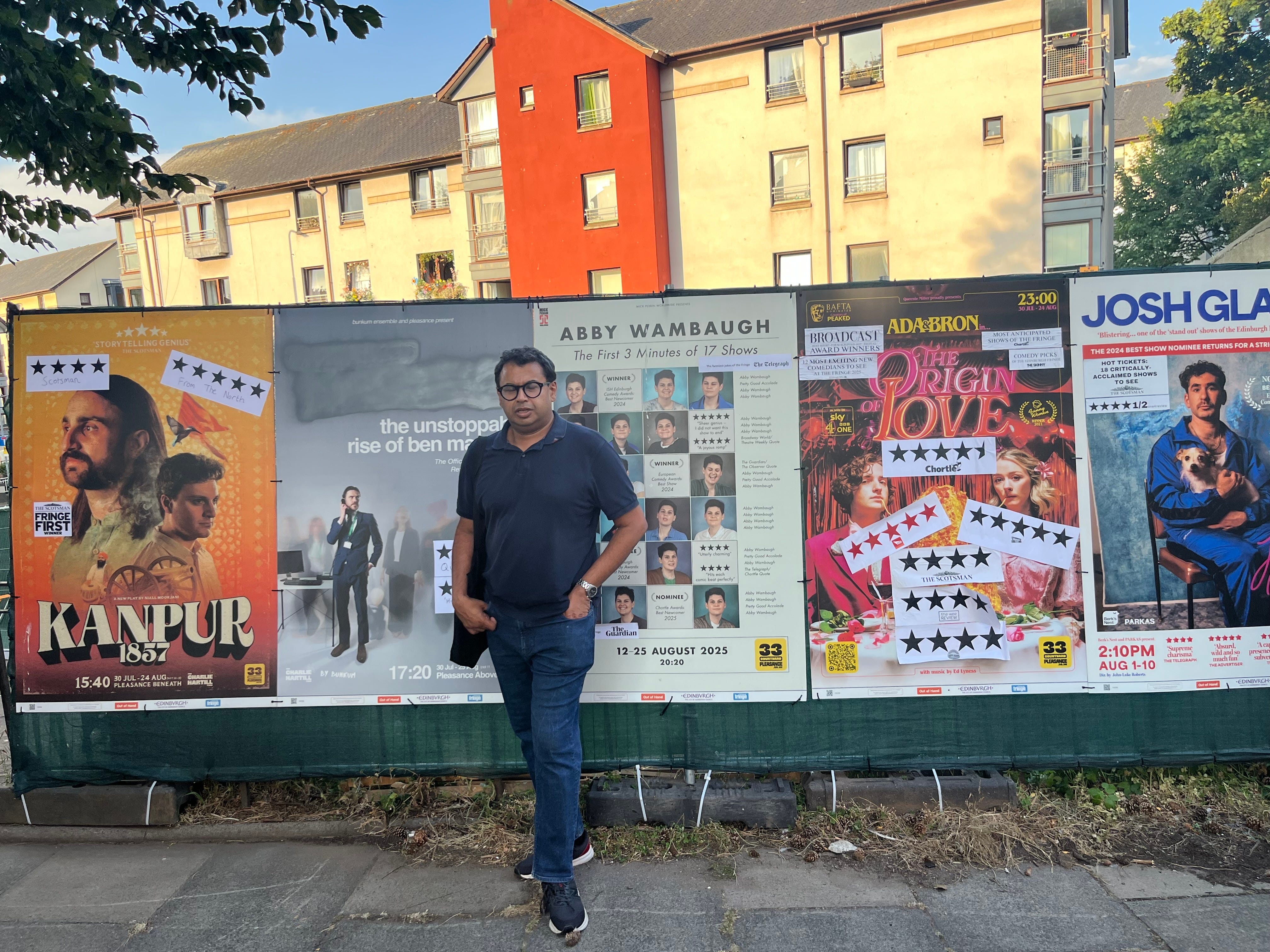
Sorry we missed you Sharath! Next time 😘